Towards a Waste-Free Africa: Highlights from the 2026 African Circular Business and Environmental Sustainability Conference (AFCBC)
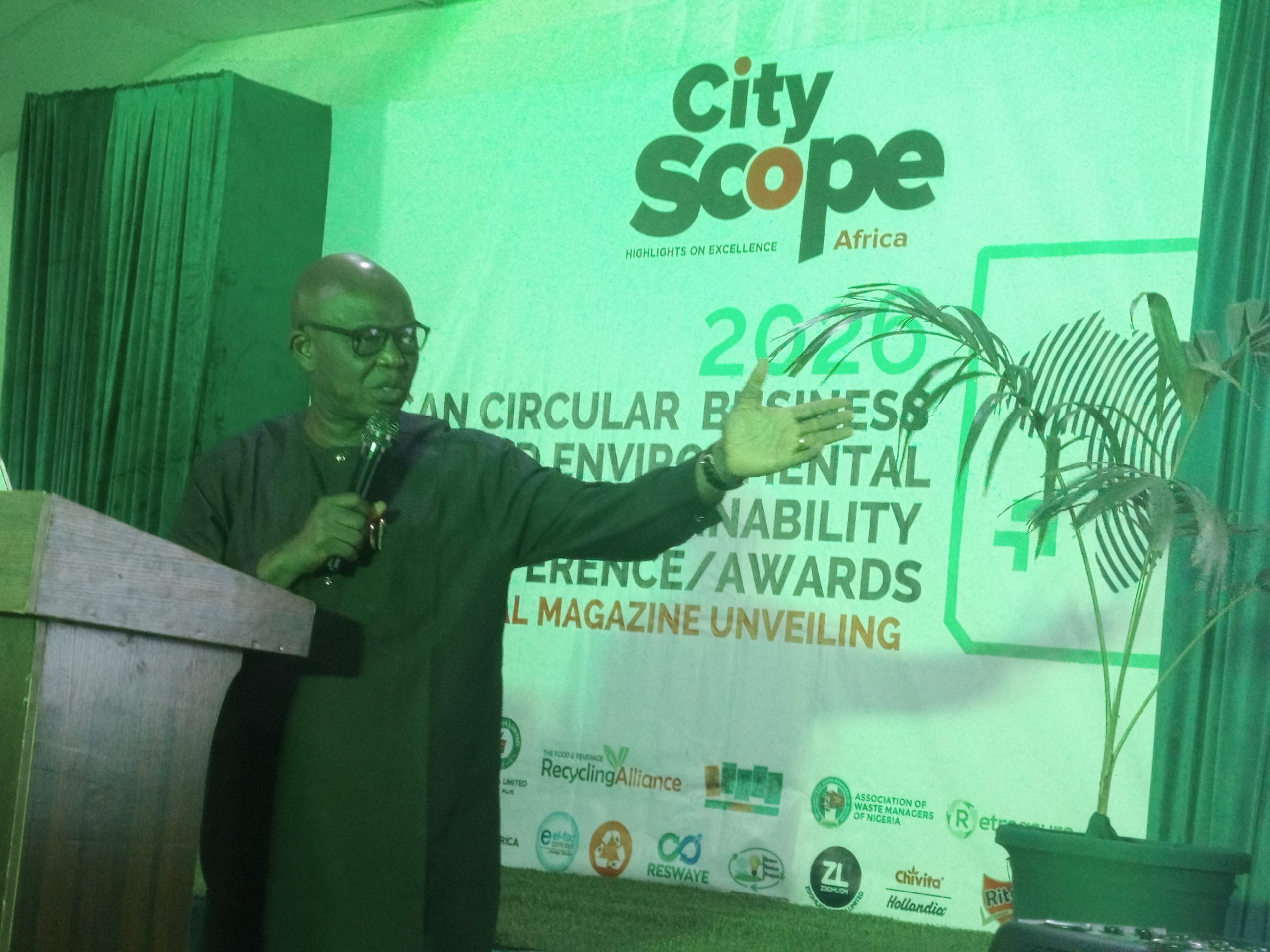
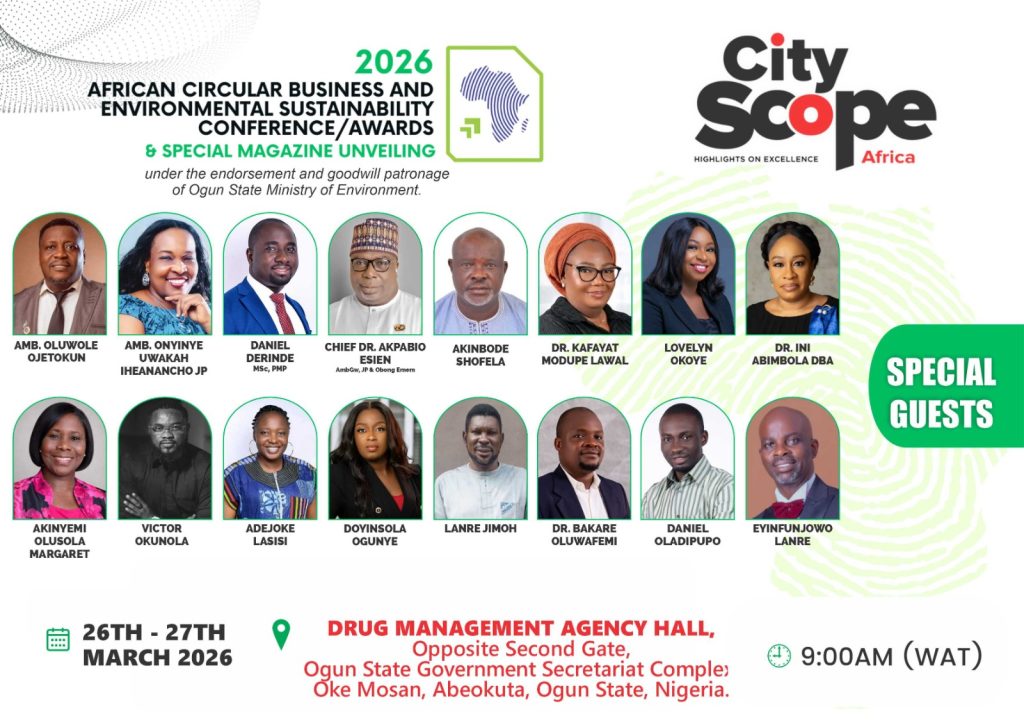
On March 26th and 27th, 2026, the city of Abeokuta, Ogun State, was charged with an ambitious atmosphere as it hosted the 2026 African Circular Business and Environmental Sustainability Conference (AFCBC).
The event served as a high-level convergence point for policymakers, industrial titans, and environmental advocates, all focused on a singular, urgent mission: transitioning Africa from the extractive “take-make-dispose” linear model toward a regenerative circular economy.
Centered on the critical intersection of environmental responsibility and policy harmonization, the AFCBC provided the definitive roadmap for a sustainable continent, punctuated by the high-profile unveiling of the CityScope Africa special magazine.
The conference was meticulously designed around three core components:
- The Conference: A series of technical sessions and policy dialogues focused on unlocking circular economic value.
- The Awards: A prestigious ceremony recognizing the pioneers driving sustainability across the continent.
- The Special Magazine Unveiling: The launch of CityScope Africa, a publication dedicated to highlighting excellence and documenting the success stories of the circular transition with the 2026 edition specilly dedicated to Dr. Ola Oresenya, the commissioner for environment in Ogun State.
Redefining the Economic Paradigm: What is Circularity?
Circularity is far more than a waste management strategy; it is a total economic transformation. By distilling the definitions provided by UNIDO, UNEP, and the European Parliament, we can define the Circular Economy as an integrated system where the value of products and materials is maintained for as long as possible. This paradigm shift prioritizes the reduction of waste through a hierarchy of sharing, leasing, reusing, and refurbishing, ensuring that recycling is a final step rather than the primary solution.
To provide a framework for this transition, the conference highlighted three “Loop Strategies” essential for managing resource flows.
The Three Pillars of Loop Strategies
| Strategy | Action (Definition/Method) | Practical Examples |
| Narrowing | Reducing the input of resources needed per product or service. | Lightweight bottles, dematerialization, and resource efficiency. |
| Slowing | Prolonging the use and lifespan of products and their components. | Repair/refurbishment of electronics, plastic bottle reuse, rental services, and Deposit Return Schemes (DRS). |
| Closing | Recycling materials for further use once they can no longer be used in their current form. | Use of recycled content, bottle-to-bottle (BtB) recycling, and energy recovery. |
The foundation of these loops lies in Design for Circularity. The following eight design focus areas were presented as a mandatory checklist for future-proofing industrial production:
- Design for dematerialization and waste prevention
- Design for attachment (addressing both emotional and physical durability)
- Design for durability and reuse
- Design for standardization and compatibility
- Design for maintenance and repair
- Design for ease of disassembly and reassembly
- Design for adaptability and upgradability
- Design for recycling
Case Study: Ogun State – The Industrial Hub of Circularity
Ogun State’s strategic designation as the “Industrial Hub of Nigeria” is not merely a title—it is a functional advantage. Its proximity to the Lagos economic ecosystem, combined with the strategic development of a new airport and expanding agro-processing sectors, positions the state as the ideal laboratory for circular business models.
The state’s ISEYA Agenda (Infrastructure, Social Wellbeing, Education, Youth Empowerment, and Agriculture) serves as the foundational bedrock for this vision. Specifically, the state is prioritizing the development of Green Infrastructure to ensure that industrial growth does not come at an environmental cost.
To catalyze this, the “Ease of Doing Circular Business” initiative was detailed, showing how the government acts as a multi-dimensional catalyst:
- Policy Enabler: By harmonizing environmental regulations with industrial policies, the government eliminates policy fragmentation, providing the predictability for investors required to commit to long-term sustainable projects.
- Infrastructure Provider: Building robust systems for recycling and waste collection to ensure materials are recovered at scale.
- Strategic Partner: Forging public-private partnerships (PPPs) to leverage shared expertise and drive innovation in resource recovery.
Technical Spotlight: Transforming Fecal Waste into Bio-Resources
A highlight of the technical sessions was the presentation by Engr. Oladele Fadipe, which reframed Fecal Waste Management (FWM) from an “environmental liability” into a “valuable bio-resource stream.” With 3.6 billion people globally lacking safely managed sanitation, the transition to circular sanitation is a public health and economic necessity.
Through advanced valorization technologies, fecal waste is being converted into high-value outputs:
- Renewable Energy: Biogas (60–70% methane) for cooking and electricity, or upgraded biomethane for gas grids.
- Agriculture & Feed: NPK-rich organic fertilizers, ammonia stripping for nitrogen fertilizers, and Black Soldier Fly (BSF) larvae processing for high-protein animal feed and biodiesel.
- Water & Revenue: Reclaimed water for industrial cooling or irrigation, and the generation of Certified Emission Reductions (CERs)/Carbon Credits to offset operational costs.
Global Best Practices
Successful models of fecal waste valorization were highlighted to prove the viability of these systems:
- Dakar, Senegal: Uses PPPs and digital truck tracking to successfully market “Fortifer” (fecal-based compost).
- Kampala, Uganda: Implements co-treatment of wastewater and organic waste to fuel biogas-to-power systems.
- Bengaluru, India: Utilizes Decentralized Wastewater Treatment Systems (DEWATS) to provide recycled water for urban landscaping.
Circular Business Models as a Competitive Advantage
Agharese Onaghise Sagay, Executive Director of the Food & Beverage Recycling Alliance (FBRA), emphasized that circularity is the primary driver for ESG (Environmental, Social, and Governance) compliance. She introduced the powerful framework “Eliminate, Innovate, Circulate” as the core vision for the continent.
The conference explored five business models driving this change:
- Circular Supplies: Using renewable or biodegradable materials as inputs.
- Product as a Service: Consumers pay for the result (e.g., lighting) rather than owning the equipment.
- Product Life Extension: Repairing and remanufacturing to keep products in use.
- Sharing Platforms: Maximizing asset utilization through shared use.
- Resource Recovery: Extracting value from waste to eliminate new extraction.
Extended Producer Responsibility (EPR) remains the engine of this transition in Nigeria. This industry-led model is currently being operationalized across four critical sectors, overseen by dedicated Producer Responsibility Organizations (PROs):
- E-waste: EPRON (E-waste Producer Responsibility Organisation of Nigeria)
- Battery Waste: ARBR (Alliance for Responsible Battery Recycling)
- Packaging Waste: FBRA (Food & Beverage Recycling Alliance)
- Tire Waste: UTPRON (Used Tire Producer Responsibility of Nigeria)
Overcoming Barriers and Seizing Opportunities
While the transition is complex, the conference highlighted that the rewards of a circular economy far outweigh the initial friction of adoption.
The Circular Transition: Challenges vs. Opportunities
| Challenges | Opportunities |
| High funding and significant investment costs | Job creation and development of green skills |
| Lack of infrastructure and limited technology | Significant contribution to GDP and economic growth |
| Regulatory barriers and policy fragmentation | Achievement of ESG and sustainability goals |
| Lack of adoptable business models | Development of innovative SMEs and projects |
| Lack of innovation and creativity | Resource, water, and energy conservation |
The AFCBC Awards and Magazine Unveiling
The event reached its zenith with the unveiling of the CityScope Africa special magazine, a platform designed to showcase African excellence in sustainability. The collaborative spirit of the conference was evidenced by the diverse array of prominent partners and sponsors, including the Ogun State Government, Nigerian Breweries Plc, FBRA, ISWA Africa, SWEEP, Chivita, Rite Foods, ZL Global Alliance, Reswaye, and the Green Building Council Nigeria.
Conclusion and Call to Action
The 2026 AFCBC concluded with a resounding vision: an Africa where waste is no longer a burden but an economic opportunity. The consensus was clear—circularity is the only pathway to long-term resilience and industrial relevance.
To realize this future, the conference issued a final charge to all stakeholders:
- Governments: Must foster a predictable environment through harmonized policies, tax incentives (such as import-duty waivers on green tech), and access to green finance.
- Businesses: Must drive innovation by adopting “Eliminate, Innovate, Circulate” frameworks and investing in valorization technologies.
- Communities: Must engage actively in sustainable consumption and support local circularity initiatives to ensure a waste-free Africa.
Dignitaries at the event included Ola Oresanya, who presented on “Ease of Doing Circular Business with Environmental Responsibility and Policy Harmonization”; Engr. Oladele Fadipe, who presented on “Circular Economy Strategies for Faecal Wastewater Management and Recycling”; Agharese Onaghise Sagay (Executive Director, Food & Beverage Recycling Alliance), who presented on “Circular Business Models, Competitive Advantage for ESG Compliant Africa” amongst others.