NAUW Marks International Women’s Day with Call for Investment in Women and Strategic Sponsorship
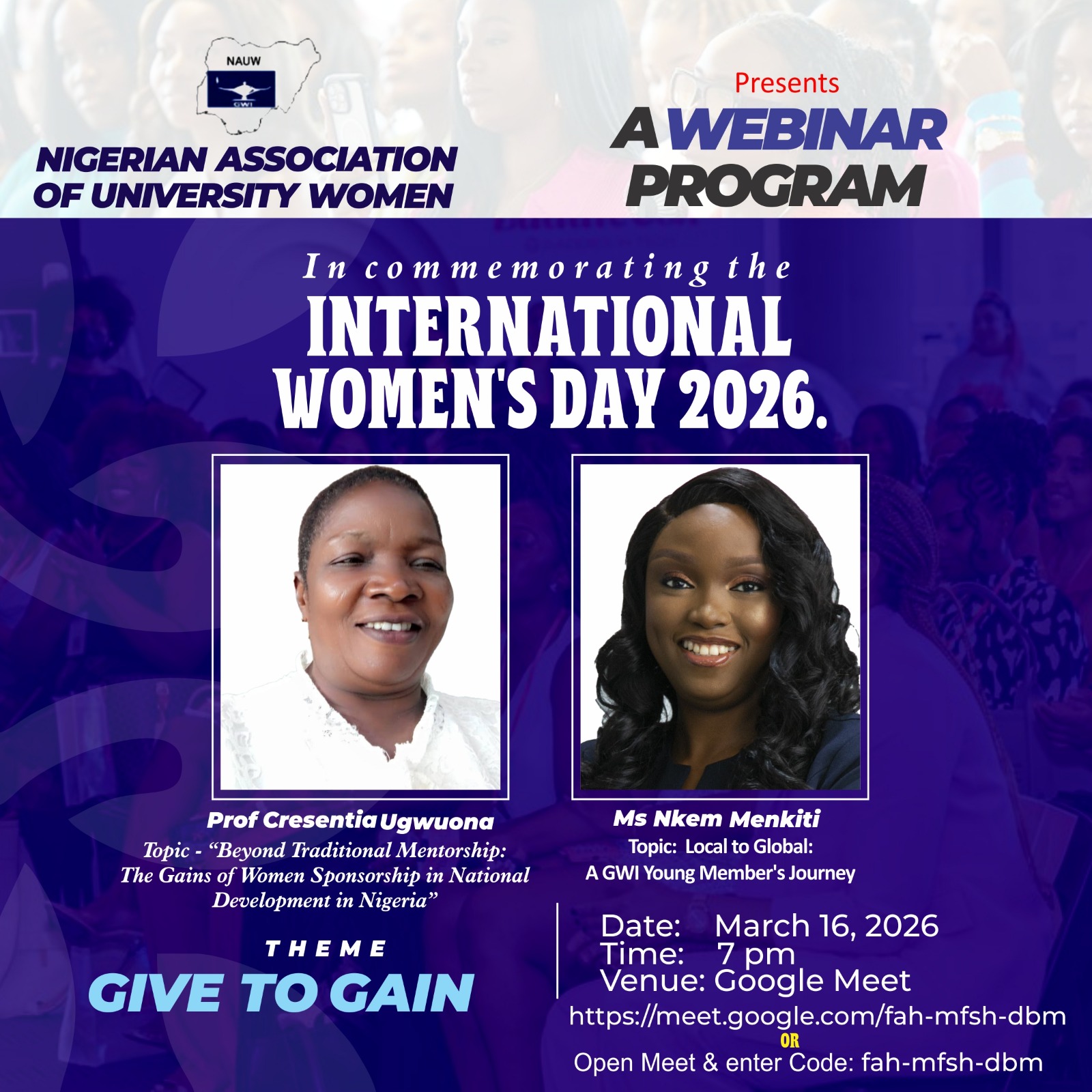
The Nigerian Association of University Women (NAUW) has emphasized the need for deliberate investment in women and girls as a pathway to national development, during an online webinar held on March 16 to commemorate International Women’s Day 2026.
The webinar, themed “Give to Gain,” brought together scholars, professionals, and advocates who explored practical strategies for empowering women from education and mentorship to sponsorship and global engagement.
In her welcome address, NAUW President, Prof. Comfort Onifade, described investing in women and girls as not only a matter of justice but also a catalyst for sustainable development and peace.
She noted that while progress has been made in advancing gender equality, more work remains to be done, particularly in ensuring access to education and leadership opportunities for women.
“Investing in women and girls is a powerful strategy for building stronger communities and achieving lasting development,” she said, while encouraging participants to actively engage and translate insights into action.
Beyond Mentorship: The Case for Women Sponsorship
Delivering a keynote presentation, Prof. Crescentia Nwaeze Ugwuona of the University of Nigeria, Nsukka called for a shift from traditional mentorship to active sponsorship as a more effective tool for advancing women in leadership.
She highlighted that while mentorship provides guidance and support, it often falls short in securing promotions and high-impact roles for women. Sponsorship, on the other hand, involves influential leaders actively advocating for and creating opportunities for women.
Prof. Ugwuona introduced the “ABCD of Sponsorship” framework, which includes amplifying women’s achievements, boosting them through recommendations, connecting them to influential networks, and defending them against bias.
She decried the persistent underrepresentation of women in leadership across Nigeria’s institutions, attributing it to systemic barriers such as cultural bias, limited access to high-visibility roles, and inadequate institutional support.
To address these challenges, she called on senior leaders to intentionally champion women, create inclusive systems, and institutionalize sponsorship programs that bridge the gap between female potential and leadership attainment.
From Local Participation to Global Influence
Also speaking at the event, Nkem Menkiti, Coordinator of International Relations at NAUW, shared insights on how young women can transition from local engagement to global impact.
In her presentation titled “Local to Global: A GWI Young Member’s Journey,” she traced her personal growth within NAUW and its global affiliate, Graduate Women International, highlighting the transformative power of active participation.
She explained that NAUW membership provides access to international platforms, including global conferences, policy engagements, and networks that empower women to influence change beyond national borders.
Menkiti encouraged young women to start small by volunteering, joining committees, and leveraging opportunities within their immediate environment.
“What if the most powerful investment you could make is in the room you are already in?” she asked, urging participants to take initiative and maximize available opportunities.
She further emphasized the importance of consistency, mentorship, and visibility in unlocking leadership potential, noting that participation at the local level can open doors to national recognition and global representation.
Across all presentations, a central message emerged: empowering women requires intentional action, sustained investment, and strategic support systems.
The speakers stressed that beyond mentorship, there is a need for structured sponsorship, inclusive policies, and active participation to accelerate gender equality in Nigeria.
The webinar concluded with a call for individuals and institutions to commit to “giving” — through time, resources, mentorship, and advocacy — as a means of achieving broader societal gains.
As participants reflected on the theme “Give to Gain,” the event reinforced the idea that empowering women is not only beneficial to individuals but essential for national and global development.